An R package to download the most up to date of these climate indices:
- Southern Oscillation Index
- Oceanic Nino Index
- North Pacific Gyre Oscillation
- North Atlantic Oscillation
- Arctic Oscillation
- Antarctic Oscillation
- Multivariate ENSO Index Version 2
- Pacific Decadal Oscillation
- Dipole Mode Index
Usage
Download Oceanic Nino Index data
oni <- download_oni()
head(oni)
#> # A tibble: 6 × 7
#>    Year Month Date       dSST3.4   ONI ONI_month_window phase
#>   <int> <ord> <date>       <dbl> <dbl> <chr>            <fct>
#> 1  1950 Jan   1950-01-01   -1.62 NA    <NA>             <NA>
#> 2  1950 Feb   1950-02-01   -1.32 -1.34 JFM              Cool Phase/La Nina
#> 3  1950 Mar   1950-03-01   -1.07 -1.17 FMA              Cool Phase/La Nina
#> 4  1950 Apr   1950-04-01   -1.11 -1.18 MAM              Cool Phase/La Nina
#> 5  1950 May   1950-05-01   -1.37 -1.07 AMJ              Cool Phase/La Nina
#> 6  1950 Jun   1950-06-01   -0.74 -0.85 MJJ              Cool Phase/La Nina
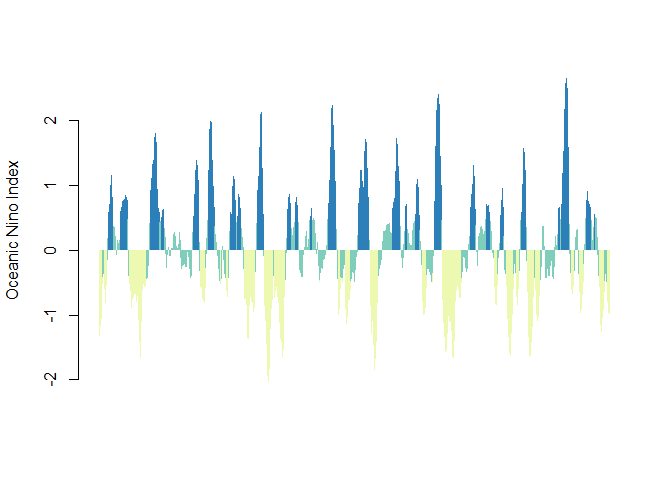
And a quick plot to illustrate the data:
barcols <- c('#edf8b1', '#7fcdbb', '#2c7fb8')

barplot(
  oni$ONI,
  names.arg = oni$Date,
  ylab = "Oceanic Nino Index",
  col = barcols[oni$phase],
  border = NA,
  space = 0,
  xaxt = "n"
)